Documentation

Welcome to Ideoz documentation

Ideoz and the Double Diamond

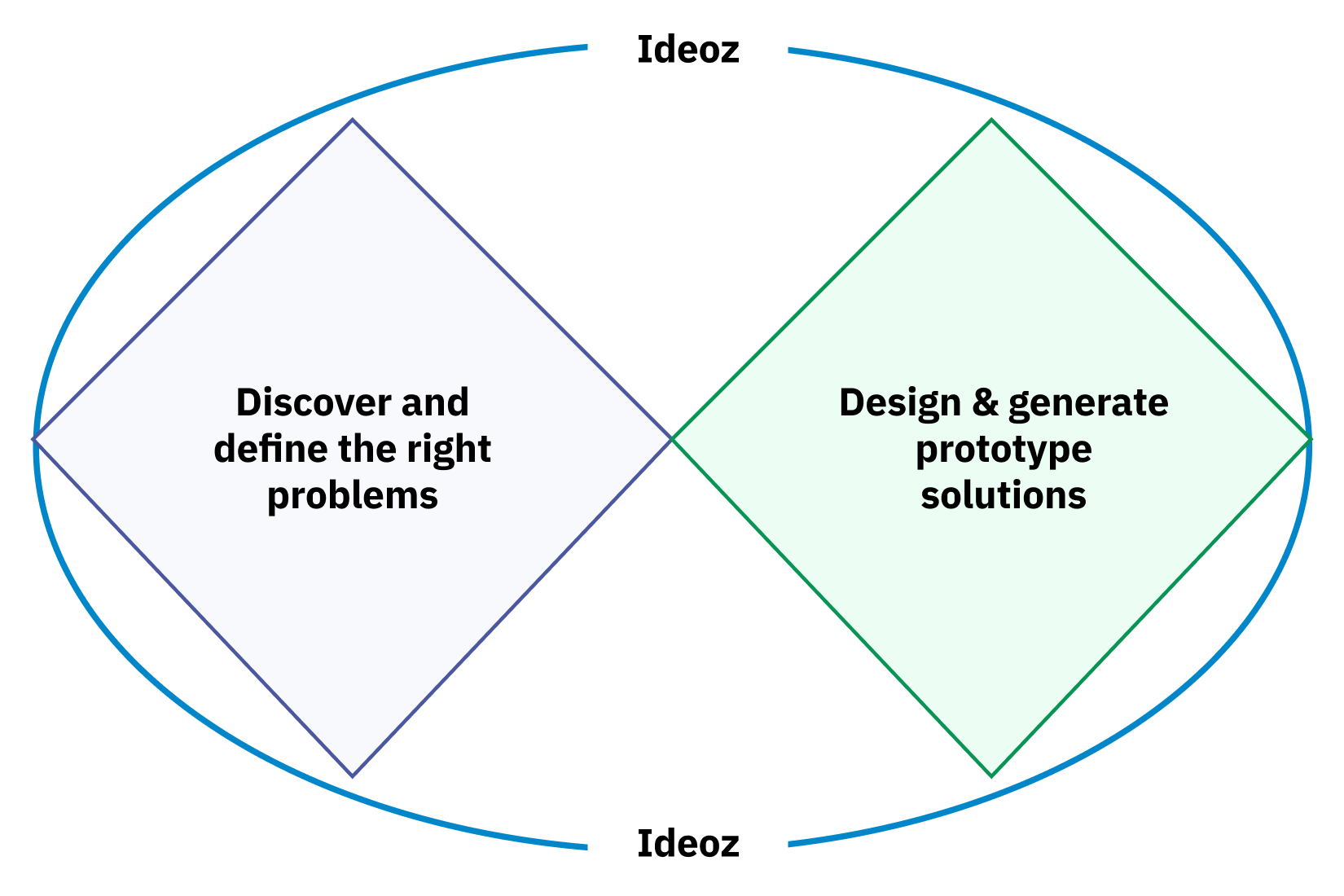
What makes Ideoz different is that it is built on the principles and core logic of the Double Diamond. Not as a diagram you have to remember but as a way of thinking that is embedded into how the product works.

The Double Diamond is widely used in product and design teams because it separates exploration from decision-making and helps teams avoid solving the wrong problem too early. Ideoz turns this way of thinking into a practical, everyday workflow.

The Double Diamond, in simple terms

The Double Diamond describes two essential shifts in thinking: 

  • Diverge before you converge 
  • Understand the problem before designing solutions

 It moves through four broad phases: 

  • Discover: explore the problem space 
  • Define: narrow down what actually matters 
  • Develop: explore possible solutions 
  • Deliver: refine and move forward 

The critical insight is not the steps themselves but it’s the sequence. Skipping the first diamond often leads to fast execution and slow regret.
How Ideoz applies the Double Diamond

Ideoz doesn’t ask you to follow a process manually. Instead, the product behavior reflects the Double Diamond logic: 

  1. Uncover supports the first diamond 
    1. Expanding understanding 
    2. Exploring causes, perspectives, and assumptions 
    3. Helping you define the right problem 
  2. Prototyper supports the second diamond 
    1. Exploring solution directions 
    2. Shaping and refining ideas 
    3. Moving toward something tangible 

You can move forward, pause, or go back at any time. The structure is there to support thinking not to constrain it.

From theory to practice

Design frameworks often fail not because they’re wrong, but because they’re hard to apply consistently under real constraints.

Ideoz bridges that gap. Instead of asking you to: 

  • Remember steps 
  • Run workshops 
  • Fill templates manually 

Ideoz: 

  • Encourages exploration when thinking is narrow
  •  Encourages convergence when exploration starts repeating 
  • Keeps context visible as decisions evolve 
  • Makes iteration cheap and reversible 

The result is not a “perfect process.” It’s better to judge quicker and move faster with confidence.

Designing with cognitive bias in mind

Good user experiences are not neutral. They are shaped around how people actually perceive, decide, and act not how we assume they do. 

Ideoz is designed with well-established cognitive and behavioral principles in mind, so the experiences you design are grounded in real human psychology.

For example: 

  • First impressions heavily influence trust and perceived quality 
  • Choice overload increases hesitation and drop-off 
  • Visual hierarchy directs attention before logic kicks in 
  • Progressive disclosure reduces cognitive load 
  • Consistency and familiarity lower learning effort

These patterns are not trends; they are repeatedly observed behaviors.

Informed by the best thinking in design and innovation

Instead of trying to be generic, the model is shaped around how designers think and work drawing from UX research, design principles, guidelines, and established best practices.

This focus allows Ideoz to generate outputs that are more relevant, grounded, and useful for real design decisions. The model is intentionally designed to help users pause, focus, clarify, and reflect at the right moments. Rather than rushing to answers, it supports better reasoning—so designers can move faster without losing depth. The goal is simple: to help you think smarter, make better decisions, and design with more confidence.

Final thought

Ideoz doesn’t replace frameworks like the Double Diamond. It makes them practical at the speed of real work.